Sarvangasana, this Sanskrit word, is a joint of three different words. ‘Sarv’ means whole, ‘Anga’ means body parts of limbs, and ‘Aasan’ means yoga postures. As the name suggests, this yoga posture has an influence on the whole body and its functions.
People of any age, be they male, female, kids, or elderly people, can practice this Aasan. But before moving forward, let us understand who should not do Sarvangasana.
Who should avoid doing Sarvangasana?
‘Sarvangasana’ is an inverted yoga posture. So all the contraindications of inverted postures should be kept in mind before moving ahead.
- People with weak hearts or suffering from high blood pressure should not practice this aasan.
- Those who are suffering from an excessively enlarged thyroid should avoid doing it. Though Sarvangasana has immense benefits for thyroids, if the thyroids are too swollen, practicing this aasan can have harmful effects.
- People with weak blood vessels in the eye and those suffering from cerebral thrombosis.
- People with slipped discs and those who have impure blood. (In case you are suffering from constipation and boils on your skin.)
7 steps to practice ‘Sarvangasana’
Regular practice of ‘Sarvangasana’ has wonderful benefits for the whole body. But this should be done properly.
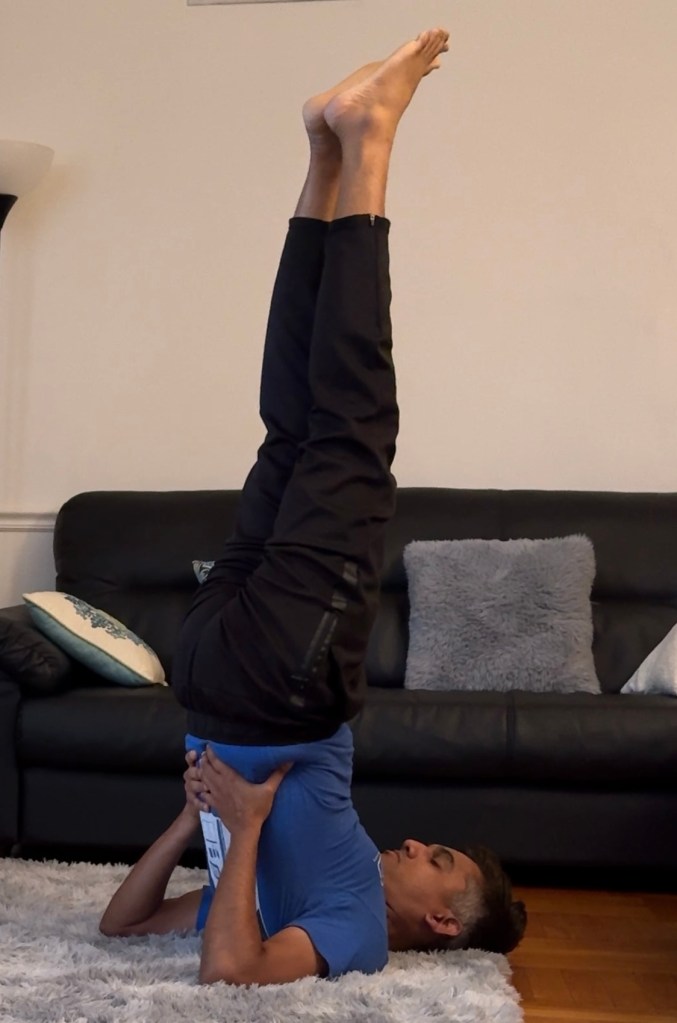
- Lie down on your back on the mat or a carpet. Place your arms on the sides of your body and your palms on the ground.
- Make sure that your head and spine are aligned. Legs are straight, and feet are together. Relax and close your eyes. Keep breathing normally.
- Contract your abdominal muscles, breathe in, and raise your legs slowly with the support of your arms (without a jerk) in the vertical position.
- Press your arms firmly on the ground and slowly lift your buttocks and spine off the floor, raising the trunk in a vertical position. Turn the palms upward, bend the elbow, and place the hands behind the ribcage, supporting the back.
- Make sure that the elbows are shoulder-width apart.
- Gently push the chest forward so that it presses firmly against the chin.
- Keep the legs together and in a straight line with the trunk. Don’t point your toes towards the sky. Keep them relaxed. Stay comfortably in the final position for five breaths, and keep breathing normally.
As you begin to release the aasan, bring the legs forward until the feet are above and behind the back of your head. Keep the legs straight. Slowly release the grip of the hand and place them on the floor. Slowly lower each vertebra on the floor, then the buttock. Here the legs are in the vertical position again. As you exhale, slowly lower the legs on the floor without using the support of the arms.
When practicing Sarvangasana, what five mistakes should one avoid?
Avoid giving physical jerks while raising and lowering your legs. The movement of the body during the raising and lowering of the legs should be slow, smooth, and controlled. Many people propel themselves into the final position, nearly risking injury to their necks.
Don’t raise the head off the ground
Do not tense the legs in the final pose. They should be relaxed and don’t point their feet.
Keep in mind that the chest should be pressed towards the chin. The chin should not be pressed towards the chest.
If you are a beginner, hold the final Sarvangasana position for five to 10 natural (normal) breaths. Keep practicing, and then slowly increase the holding time.
Benefits of Sarvangasana
Thyroid
During this position, good blood flow is directed to the thyroid gland. The curvature of the neck can restrict the normal flow of blood to the brain through the external carotid arteries. This flow is directed to the thyroid gland. Thus, the thyroid is flushed and nourished with an extra supply of blood.
Digestive system
Organs like the liver, intestine, and pancreas are prone to blood congestion, which reduces their efficiency. Inverted asanas can help to drain the accumulated blood so that it can be replaced by a fresh supply of blood.
In this posture, the liver also receives a good massage.
Circulation System:
Gravity aids in the blood supply to the lower limbs of the body. While returning to the heart, the forces of gravity tend to impede the blood flow. This can cause stagnation of the blood in the lower limbs, resulting in ailments like varicose veins. During this aasan, the stagnated blood in the lower limbs is able to supply nourishment to the different regions of the body.
 Mayank Bhagwat