The Centers for Disease Control and Prevention (CDC), a premier health agency in the U.S., has issued a health advisory following the detection of a human transmission case of avian influenza in Texas, United States.
The health alert was issued on Friday, April 5th, to inform clinicians, state health departments, and the public of a recently confirmed human infection with the highly pathogenic avian influenza (HPAI) A (H5N1) virus following the likely exposure to the infected dairy cattle.
According to the Animal and Plant Health Inspection Service, six states in the United States—Texas, Idaho, Michigan, Ohio, Kansas, and New Mexico—have reported confirmed cases of avian influenza in domestic livestock.
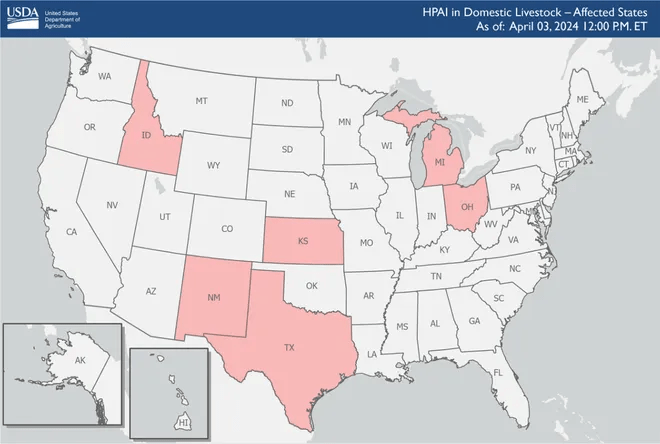
((Image Source: Animal and Plant Health Inspection Service, U.S. Department of Agriculture))
Globally, since 2003, 873 human infections with A (H5N1) viruses, including 458 deaths (CFR 52%), have been reported to the WHO. Two cases of avian influenza infection in humans were reported in the UK in May 2023.
What do we know about the human transmission case?
On March 27, 2024, a farm worker on a commercial dairy farm in Texas developed conjunctivitis. Subsequently, he also tested positive for a highly pathogenic avian influenza A (H5N1) infection.
HPAI A (H5N1) viruses have been reported in the area’s dairy cattle and wild birds. There have been no previous reports of the spread of HPAI viruses from cows to humans.
The worker reported conjunctivitis with no other symptoms, was not hospitalised, and is recovering now. The patient has been isolated and has received antiviral treatment. None of his family members have tested positive for the disease.
The Texas worker is the second person to have tested positive for avian influenza in the United States. The first case was reported in April 2022 in Colorado.
Low risk to the general public
According to the CDC, the current risk that these avian influenza viruses pose to the public remains low. However, the health watchdog has warned people with job-related or recreational exposures to infected birds, cattle, or other animals who are at higher risk of infection to take appropriate precautions.
“No additional cases of human infection with HPAI A (H5N1) virus have been associated with the current infections in dairy cattle and birds in the United States, and no human-to-human transmission of HPAI A (H5N1) virus has been identified,” states the CDC.
Currently, HPAI A (H5N1) viruses are circulating among wild birds in the United States, with associated outbreaks among poultry and backyard flocks and sporadic infections in mammals.
The CDC has sequenced the genome from the patient sample and has compared it with the sequence from birds, cattle, and poultry. The CDC says, “While minor changes were identified in the virus sequence from the patient compared to the viral sequence from cattle, both the cattle and human sequence lack changes that would make them better adapted to infect mammals.”
What is bird flu?
Avian influenza, also known as ‘bird flu’, primarily affects birds and is caused by a virus of the Orthomyxoviridae family.
These viruses naturally spread among wild aquatic birds worldwide and can infect domestic poultry and other bird and animal species. Bird flu viruses do not normally infect humans. However, sporadic human infections with bird flu viruses have occurred in the past.
According to the World Health Organization, “Avian, swine, and other zoonotic influenza infections in humans may cause disease ranging from mild upper respiratory infection (fever and cough) to rapid progression to severe pneumonia, acute respiratory distress syndrome, shock, and even death.”
Gastrointestinal symptoms such as nausea, vomiting, and diarrhoea have been reported more frequently in A (H5N1) infections. Conjunctivitis has also been reported in influenza A(H7).
The first case of avian influenza was reported in Hong Kong in 1997. Since then, the disease has been responsible for human outbreaks and deaths in 16 countries in Africa, Asia, Europe and the Middle East. According to the WHO, in 2006, avian influenza caused by the highly pathogenic A (H5N1) influenza virus spread rapidly through the Eastern Mediterranean Region, with large non-human outbreaks reported in Afghanistan, Djibouti, Egypt, Iraq, Jordan, occupied Palestinian territories, Pakistan, and Sudan.
The incubation period for A (H5N1) ranges from 2 to 5 days on average and up to 17 days. Symptoms of infection in humans include fever, malaise, cough, sore throat, and muscle aches. Severe disease and death may result from a complication of pneumonia. The case fatality rate for avian influenza among humans is much higher than that for seasonal influenza infection.
Globally, since 2003, 873 human infections with A (H5N1) viruses, including 458 deaths (CFR 52%), have been reported to the WHO.
In a press statement issued on April 2nd, Cal-Maine Food Inc. said, “One of the company’s facilities located in Parmer County, Texas, tested positive for highly pathogenic avian influenza (“HPAI”). The company has destroyed approximately 1.6 million laying hens and 337,000 pullets, or approximately 3.6% of the company’s total flock as of March 2, 2024.” Production at the facility has temporarily ceased after the outbreak. https://www.calmainefoods.com/press-releases
 Mayank Bhagwat